
Apex Valves: From garage to global
From humble beginnings in a Titirangi garage, Apex Valves has grown into one of New Zealand’s standout manufacturing and export success stories. Built on precision engineering and commitment to quality, the company now supplies high performance water control valves to homes and farms around the globe.
The EMA’s Nicholas Russell sat down with Apex General Manager Mark Gracie to talk about the competitive edge that comes from manufacturing excellence backed by decades of innovation.
Q: How did Apex Valves’ journey begin, and what triggered your move into larger-scale manufacturing?
Mark Gracie: Apex was founded in 1982 by my father, Alan Gracie, in a Titirangi garage. At that time, New Zealand had almost no domestic manufacturers of valves for home hot-water systems.
If you needed one, you imported it, often at high cost and with long delays. That gap in the market sparked the idea: could a Kiwi manufacturer produce a reliable, locally made alternative?
From that question, Apex grew steadily. We expanded from residential hot-water valves into broader plumbing fittings, and then into agriculture when a rural-supply customer asked if we could engineer a heavy-duty trough valve that would not break under high water pressure or daily farm use.
That product became our breakout success. More than 40 years later, that trough valve remains one of our biggest sellers, used on farms across New Zealand and in multiple export markets.
As demand grew, we shifted into proper manufacturing facilities, but over time those sites became limiting. Our last location served us for 28 years, but we were spread across four buildings, with production split into disconnected pockets.
For a company that prides itself on quality and efficiency, the layout created unnecessary complications and increasing constraints.
Q: What has changed now, after the move to your new facility at Rosebank Road?
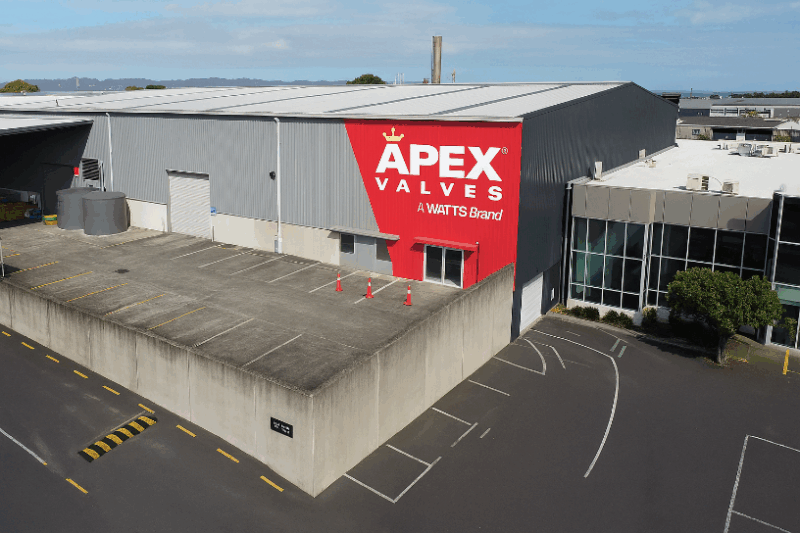
Mark Gracie: The Rosebank Road move has been transformational. It is not just a relocation but a complete rethink of how we manufacture. Our retrofitted 4100m² facility allowed us to engineer a coherent flow through the whole production cycle.
Instead of piecing operations together over the years, we were able to design for efficiency, safety, ergonomics and growth.
Our old layout had forklifts crossing walkways, benches fixed at one height, and assembly staff improvising, sometimes literally standing on boxes, to work comfortably.
Now every station is height adjustable. Lighting is optimised for precision work. Forklift and pedestrian routes are physically separated. We have laid out production in a clear U-shaped flow. Raw materials come in at one end, move through machining, processing and assembly, and leave through dispatch at the other.
That seems simple, but the impact on productivity, safety and morale has been enormous.
The new space is also about investing in people. When staff saw the new building for the first time, their reaction said it all. There was pride, excitement, and relief that their daily environment finally matched the professionalism of the work they do.
Q: What upgrades have helped the most?
Mark Gracie: The wet lab is one of the most significant upgrades. Valves endure huge variations in pressure, flow and temperature when used in real environments, especially in agriculture where water may arrive freezing, muddy, high pressure, or full of sediment.
You can only guarantee performance by replicating those conditions during testing.
Our wet lab lets us do exactly that. We harvest rainwater on-site, filter and sterilise it with UV treatment, then circulate it through a controlled test system. Pumps, chiller units and temperature-controlled tanks allow us to simulate years of wear in a compressed timeframe.
We run thousands of cycles to test endurance, pressure spikes, flow rates and thermal extremes. This gives us confidence before products reach farms, homes or export markets.
The wet lab speeds up R&D, strengthens quality control and helps us meet global certification requirements.
Q: How has that journey been for Apex?
Mark Gracie: Apex has been exporting for decades, mostly to countries with strong agricultural sectors. Today we ship to about 13 countries. One milestone we are particularly proud of was winning the Whirlpool business.
It’s one of the top global manufacturers of whiteware and they tested valves from five suppliers around the world. Ours was the only valve that passed every requirement. That opened the door to a long-standing supply partnership and validated the reputation we had been building. Kiwi-made products can and do outperform global competition on quality.
Q: How has your partnership with the EMA evolved?
Mark Gracie: The EMA has been a significant part of our journey. We have been members for many years. In our early growth stages, the EMA’s support around HR, employment law, health and safety and general compliance was essential.
Like many manufacturers, we were strong technically but needed guidance on people management and regulatory frameworks.
I went to the EMA’s Global X summit earlier in the year and it’s great to join a community of manufacturers who share knowledge and experiences.
For a country like New Zealand, which is small, remote, and heavily reliant on exporting, these EMA networks are vital in building confidence, knowledge, and opportunities for growth.
Q: Where does Apex fit into New Zealand’s broader manufacturing story?
Mark Gracie: We design and manufacture high-precision, high-reliability products that solve specific, real-world problems. What we see emerging across the country is a manufacturing sector that may never match the scale of global giants but consistently excels in niche innovation, specialist engineering and technologies designed for harsh environments.
That is where New Zealand shines, and it is exactly where we want to keep pushing.


