
Busy Isn’t Productive: The Hidden Cost of Broken Flow
A practical reset for factories stuck in firefighting, batching and workarounds.
 By Neil Robinson, a Senior Business Consultant with Argon & Co (Auckland) specialising in productivity improvement, Lean systems and capability building. A Six Sigma Black Belt and experienced facilitator, he helps manufacturing teams make flow visible, stabilise performance and embed practical continuous improvement routines from frontline to leadership.
Busy isn’t productive. Most manufacturing leaders have seen it up close: people are flat out, machines are running, forklifts are moving — and yet output, delivery and margin are unacceptable.
The hidden cost isn’t laziness or lack of commitment. It’s broken flow.
If you’ve ever launched a “transformation initiative” that looked perfect in the boardroom but lost momentum on the shop floor, you’re in good company. Programmes rarely stall because people don’t care.
They stall because the one thing everyone needs to understand — how work actually flows — was never made visible in a way that sticks.
Flow is the backbone of every World Class operation. When product moves smoothly from one step to the next, everything improves: quality, productivity, lead time, DIFOT, cost and morale.
But when flow is interrupted, busyness increases, work piles up, frustration grows and improvement stalls — even with good people trying hard.
Why flow matters — and why it’s hard to teach
Every operation wants work to move smoothly from start to finish. When flow is strong, performance becomes predictable.
When flow breaks down, the system pays — in delays, rework, expediting, excess WIP, stressed teams and missed delivery.
The enemies of flow often look “normal” in day-to-day work: batching, long changeovers, unclear priorities, waiting for information or materials, bottlenecks, and the classic workaround — “just put it anywhere for now.” These interruptions are easy to tolerate individually, but together they quietly drain productivity.
You can explain flow in a meeting, map it on a wall, and measure it in a report — but until people experience what disrupts flow and what restores it, the learning doesn’t stick.
That’s why so many improvement programmes struggle: teams may agree in theory, but they don’t share the same picture of what good flow looks like in practice.
Making flow visible without the slide deck
That’s where the 4×4 Simulation comes in — an energetic, tactile, highly interactive learning experience that makes flow visible in a way no slide deck ever could.
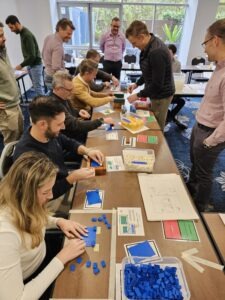 It’s practical, visual, surprisingly funny at times, and it consistently triggers the question every manufacturing leader wants their team asking – “Why don’t we work like this at our place?”
When participants walk into the room, they’re greeted by what looks like an innocent LEGO® assembly process.
Within minutes, that “factory” becomes a lively, noisy, slightly chaotic production environment.
People step into familiar roles — operator, forklift driver, engineer, quality inspector, team leader — and begin building a three-tower product. The facilitator sets a target that appears reasonable.
What happens next usually triggers equal parts recognition, resignation and laughter.
Material runs out. Engineering changeovers take forever. Workstations are scattered. Quality issues snowball. Operators get overloaded while others wait. Forklifts travel more than a courier on rural delivery day.
And the result? Most teams achieve only a fraction of the target output.
It’s not failure — it’s the point. Participants are experiencing the same hidden interruptions that destroy flow in real factories, warehouses, distribution centres and service operations every day. And because the learning is physical and immersive, it sticks.
Teams quickly see the big picture: the problem isn’t the people — it’s the system.
The “Aha” moment: building flow on purpose
Between simulation rounds, participants review what disrupted flow, what created waste, and what simple changes could unblock the system. This is where the learning becomes powerful, because improvements aren’t “told” — they’re discovered.
They soon realise flow improves when:
- layouts shorten travel distance
- roles and priorities are clear
- quality issues are caught early and solved at the source
- product changes are simplified and changeovers reduce
- work is balanced across the line
- waste is removed from the process
And the biggest insight of all:
Flow relies on the whole system working together — not individuals working harder.
This is the moment someone inevitably asks: “Yes, but how do we do this in our real factory?”
Perfect. That question means they’re ready.
Why “World Class” matters more than “Lean”
The tools used in the simulation — visual management, 5S, pull systems, workplace organisation, quality at source, set-up reduction, teamwork — are often labelled “Lean.” We talk about World Class and Best Practice because those terms resonate better with today’s teams and avoid the baggage of poorly executed “Lean projects” of the past.
Flow is universal. World Class performance is universal. What matters is helping people understand what “great” looks like — then showing them practical steps to get there.
Designed for the front line — and built to stick
The one-day version of the 4×4 Simulation is an ideal introduction for operators, leads and supervisors — the people who ultimately create and protect flow every day. It’s fast-moving, energising, team-based, and full of light humour and good-natured competition.
By Run 3, the room feels completely different. The same team, in the same time, with the same materials — yet flow is smooth, roles are aligned, quality is stable, and productivity lifts dramatically.
Participants don’t just talk about flow — they’ve built it.
Practitioners, not theorists
Every workshop is led by experienced manufacturing consultants who have spent years inside real factories. They understand daily pressures, constraints, personalities and workarounds — and they know how to translate theory into practical, achievable action.
The style blends credibility, humour and encouragement. The aim isn’t to tell people what they “should” do. It’s to help them discover what truly works — and how to apply it in their own operation.
A practical reset for underdelivered improvement
If previous transformation efforts lost steam — or if you’re ready to re-energise your teams with something practical, visual and motivating — the 4×4 is an ideal starting point because it answers the two questions that matter most:
- What does great flow actually look like?
- How do we create it in our own operation?
If you want your people to see the system, understand flow at a deep level, and experience what World Class really feels like, the 4×4 Simulation will do exactly that.
Feel free to call and discuss if this dynamic simulation is suitable for your organisation and if so, how we might make it happen.
Neil Robinson 021 873 214 neil.robinson@argonandco.com


