
The cost of Deindustrialisation: How New Zealand’s manufacturing decline threatens our economic future
NZ Manufacturer magazine wants more business owners and decisionmakers to speak up and positively make suggestions on issues affecting the future of manufacturing. Dont be silent when your ideas can make a difference. Speak up for your country. Doug Green, Publisher
By Sean Doherty, Manufacturing Commentator | NZ Industry Trends
 Manufacturing is not just another sector in New Zealand; it is one of the core systems that keeps regional communities alive and anchors our standard of living.
When factories close in Whakatāne, or the outer suburbs of Christchurch, we do not seamlessly “move up the value chain.” We lose well‑paid careers, technical capability, and the dense network of firms and supply chains that make an economy resilient.
The signs of deindustrialisation are already all around us
Long‑standing manufacturing plants shutting, production shifting offshore, and investment decisions quietly goes against New Zealand.
The immediate impact is job loss, but the deeper damage is structural.
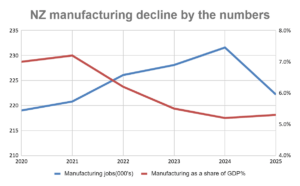 Manufacturing has long provided thousands of solid, mid‑skill, mid‑wage jobs for people who are prepared to learn a trade, run complex processes, and take responsibility for quality and output.
As these roles disappear, the labour market splits into a small group of high‑income professionals and a growing pool of low‑paid service jobs in areas like tourism and hospitality.
That mix locks in stagnant wages, weakens social mobility, and drives up fiscal pressure as more households rely on government support to close the income gap.
For regions, the consequences are even more personal. A single plant in a provincial town can support hundreds of families directly and many more through suppliers—maintenance firms, transport operators, engineering workshops, automation integrators, local business services.
When production ceases, these networks unravel. Young people see fewer reasons to stay, schools lose roll numbers, and community struggle.
Once this cycle takes hold, it is extremely hard to reverse. The story is familiar from deindustrialised regions overseas; New Zealand is not immune.
Yet the debate often treats manufacturing as yesterday’s story, or assumes that “services will replace it.” That is wishful thinking. Services matter, but they do not easily replicate what manufacturing does for productivity, exports, and regional balance.
Manufacturing is where process improvement, automation, and digital technologies are pushed hardest. It is where exporting firms learn to compete globally.
Without a strong industrial base, we risk becoming a price‑consumer in both goods and technology, heavily dependent on imports for essential equipment, and vulnerable to supply shocks we cannot control.
New Zealand’s specific barriers are well known: High and increasing energy costs for large users, thin domestic capital markets, skills shortages in engineering and trades, and slow, fragmented technology adoption across thousands of small and medium manufacturers.
Left unaddressed, these pressures push investment offshore where energy is cheaper, markets are deeper, and industrial policy is more ambitious.
That is how deindustrialisation accelerates—not with a single crisis, but through a steady drip of “no” decisions in corporate boardrooms.
We face a choice. We can continue with incremental, reactive government policy and watch our industrial base slowly erode. Or we can treat manufacturing as a strategic asset and design a long‑term industrial policy aimed at growth, not mere survival.
In my opinion, here are the three key areas the government needs to invest in urgently:
First, skills. The government should put manufacturing skills at the centre of its industrial strategy: modern apprenticeships that blend traditional trades with automation, robotics, and data; strong partnerships between manufacturers, schools, and tertiary providers; and long‑term funding that supports continuous upskilling, not just short‑term training schemes.
The test should be whether a young person in any region can see a credible, well‑paid industrial career without leaving their community.
Second, technology adoption. Rather than scattering small grants, policy should de‑risk real transformation with targeted incentives tied to measurable productivity and export gains, supported by advisory services so firms learn to redesign processes, not just buy machines.
Public investment with manufacturers should also require sharing best practice and building local clusters so other firms can learn faster and lift performance together.
Third, energy reform. If we want a modern, electrified, low‑carbon industry in New Zealand, we must ensure manufacturers can access reliable, competitively priced power over the long term.
That will require reforms that reduce avoidable regulatory costs, enable long‑term supply arrangements for industry, and support investment in energy infrastructure and generation.
New Zealand still has pockets of world‑class manufacturing talent and firms that prove what is possible. But the window to build on those strengths is narrowing.
The choice in front of us is stark: confront our structural issues in skills, technology adoption, and energy with a serious, long‑term industrial strategy—or accept a future of faster deindustrialization, more fragile regions, and a thinner base of well‑paid, productive work.
We cannot drift our way to a strong manufacturing future; we have to decide that we want one.


