
Science reform: The missing link in NZ’s manufacturing productivity puzzle ?
The Problem We Have Been Ignoring
 By Sean Doherty, Manufacturing Commentator | NZ Industry Trends
Ask any manufacturer about their biggest constraints and the answers are familiar: energy costs, skilled labour, margin pressure, and global competition from economies with far greater scale.
What rarely comes up is New Zealand’s persistent underinvestment in the science and technology that lifts productivity.
That gap is real. New Zealand’s total R&D investment sits at around 1.5% of GDP, well below the OECD average of 2.7%, and business investment is under 1%, among the lowest in the developed world. This shortfall is estimated to account for up to a third of our productivity gap.
But this isn’t just about how much we spend. It’s also about how well manufacturing and science connect. When that link is weak, research struggles to reach the factory floor and manufacturers miss out on practical solutions.
When it works, the gains are clear: better products, improved materials, and performance that carries through to export outcomes and productivity gains.
All of this sits against a broader shift. Manufacturing’s share of GDP has halved since 2004, and close to 60% of what remains is concentrated in dairy, meat, food, and timber processing. These sectors matter, but focusing most of our limited science effort there won’t deliver the step change in productivity or living standards we’ll need.
At best, it sustains incremental gains in mature industries. If we want a different trajectory, the focus has to shift toward building new capability, not just reinforcing what we already do well.
What the 2026 Science Reforms Change
The Government’s Science Investment Plan 2026–2036 is the most significant restructure of New Zealand’s research system in more than a decade. It also chooses a clear mission based focus and puts commercial outcomes as key objectives.
Seven Crown Research Institutes are being replaced by three new Public Research Organisations focused on Earth Sciences, the Bioeconomy, and health, plus a fourth dedicated entirely to advanced technology.
That fourth body, the New Zealand Institute for Advanced Technology (NZIAT), is the one that will resonate most for manufacturers.
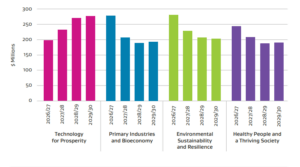
Backed by $231 million investment, NZIAT seems to be set up as a practical “hub-and-spoke” outfit that connects science capability to manufacturers, not academics to other academics.
Its focus areas under “Technology for Prosperity” are exactly where manufacturers are heading next: artificial intelligence, machine learning, and advanced materials.
This isn’t blue‑sky science. AI and machine learning are already running many applications in quality inspection, predictive maintenance, and supply chain optimization in factories today. Advanced materials from smart composites to next‑gen magnets are driving new levels of precision in manufacturing, aerospace components, and industrial processes.
The research system is now being shaped around a single question: what economic problem does this actually solve?
It’s no surprise many scientists worry that, in chasing short‑term commercial impact, we’re weakening the longer term pipeline of discovery and capability building.
Change always comes at a cost, and the trade‑offs here are real. Primary industry and Bioeconomy research has been trimmed, environmental science has taken a hit, and the Marsden Fund now expects half of its grants to show a clear economic payoff.
Investment across Pillars between 2026/27 and 2029/30 (includes both contracted and uncommitted investment) Source MBIE science investment plan 2026-2036
Step Change or Callaghan 2.0?
Change was needed. That part is obvious. The real question is whether this is actually a step forward, or just the same system under a different name.
From a manufacturing perspective, that distinction matters. NZIAT could become a genuine bridge between science and industry, focused on real problems and lifting productivity. But it could just as easily fall back into familiar patterns, where the structure changes but what happens on the ground does not.
We have been here before, and New Zealand does not have the scale or capital to keep going through cycles of reset without seeing a real shift in outcomes.
In the end, this will not be judged on how it is set up or what is promised. It will come down to whether manufacturers are more productive, more competitive, and better able to grow.
If that does not change, it is hard to call it reform. It is just a rebrand.


