
From Garage to Global: 20 years of Brolly Sheets
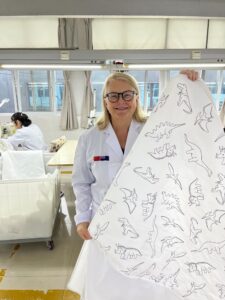 Family-owned, Kiwi-designed brand Brolly Sheets began with a problem at home. Founder Diane Hurford sewed the first Brolly Sheet after repeated middle-of-the-night bed changes during toilet training.
The reusable, absorbent, waterproof bed pad quickly gained traction. What started as a homemade solution grew into a New Zealand manufacturing and export business.
On the company’s 20th anniversary, Diane speaks with the EMA’s Nicholas Russell about the journey from a single prototype to large-scale production.
Brolly Sheets grew from a home and garage-based operation into a major exporter with international manufacturing partners. Tell us about your expansion journey.
Diane Hurford: I started working with James, who runs a small countryside factory in China, almost 20 years ago. I actually found James on Alibaba.
I contacted a number of manufacturers and received plenty of responses, but James stood out because he clearly understood the product and the manufacturing process.
Back then, Alibaba was a much smaller platform and there were real risks. Anyone could create a profile, so there was no guarantee you were dealing with a legitimate business. I was lucky to find someone I could trust.
At the time, James worked for a larger manufacturer. As our relationship developed, he made the decision to leave and start his own company, with Brolly Sheets as his very first customer.
Today, his business manufactures products for companies around the world, and we’re still working together.
That first trip to China to meet James was nerve-wracking – meeting a stranger at the airport and driving three hours to a hotel in a different town.
It proved worthwhile. James and I have built our businesses together ever since, and we alternate visits each year. It’s a genuine friendship.
Your products are designed in New Zealand but manufactured offshore. What led you to that decision?
A business mentor gave me three options, and it really clarified the decision.
The first was to keep manufacturing in New Zealand and keep the retail price the same. That would leave almost no margin to grow the business, invest in marketing or develop new products. Basically, a hobby, not a sustainable business.
The second option was to keep manufacturing locally but significantly increase the retail price.
I’d already done the research, and while people are often prepared to pay a premium for locally made clothing or handbags, they weren’t willing to pay substantially more for a product to protect a bed from wee!
The third option was to manufacture offshore, build a high-quality product and create the margins needed to run a sustainable business. It was definitely a risk, but it meant we could keep the product affordable for families while giving the business room to grow. And the concept, design, development and testing all still happen here in New Zealand.
When we started, I managed every aspect of the customs, shipping documentation and product compliance myself.
There wasn’t a handbook to follow, so I spent countless hours researching, talking to people and attending every workshop and course I could find.
It was very much a case of learning as I went. I’ve always looked for opportunities to learn from others, from programmes like PLATO (Peer Learning Through Assisted Organisation) in the early days to the EMA’s workshops and the Excelerate 100 programme more recently.
They gave me practical knowledge, valuable insights and the confidence to keep growing the business.
Working remotely means trust and communication are critical. Issues need to be raised openly and addressed quickly, which only happens when you treat people as partners rather than suppliers.
Brolly Sheets places a strong emphasis on ethical manufacturing. What do you look for in a manufacturing partner?
Diane Hurford: I’m especially proud that most of our products are made in a small countryside factory that values people as much as output. James manages it, his sister leads the machinists, and their father cooks lunch for the team every day. It’s a family operation in the truest sense.
Workers are paid by the hour, and that shows in the quality. Because it’s a rural factory, the women go home to their families each evening – something many city factory workers don’t get to do.
Sustainability is becoming more important in manufacturing. How has Brolly Sheets approached waste, packaging and product lifespan?
Diane Hurford: For us, sustainability is about giving families a better option. Reusable and disposable products both have a place, but every swap makes a difference.
Whether it’s a Brolly Sheet instead of disposable bed pads, or Snazzi Pants instead of disposable trainers, it adds up.
Durability sits at the centre of our approach. Our Brolly Sheets have a 100% cotton top, polyester-backed PUL waterproofing, and are Green Leaf certified.
We often hear from families still using the same product after 10 years. That’s what we design for.
Beyond the product, we use plastic-free packaging where possible, recycle cardboard and soft plastics, and plant trees through our Ecologi forest. It’s not about being perfect but about making better choices easier.
Many manufacturers talk about innovation, but customer feedback often drives real improvements. How important has this been for you?
Diane Hurford: Our customers have shaped this business as much as I have. We talk to families at expos and events, then take that feedback straight into product development.
It’s changed the direction of the business. We started with toilet training, but customers showed us the overlap with disability and aged-care needs.
A family might come to us for one product and discover we also support other stages of life.
We stay close to reviews and customer conversations. If something needs improving, we act on it. If there’s a gap, that often becomes the next product.
It’s less about deciding what people need and more about listening closely and responding.


