
New Zealand talks about productivity, but does not build the capability to deliver it
From July 2026 issue, NZ Manufacturer magazine.We invite readers to feedback to us on this excellent article. How do you see things? How is Productivity in your workplace?
Ian Walsh, Partner, Arg on & Co
New Zealand does not have a shortage of productivity commentary. We have reports, benchmarks, speeches, and strategies. What we lack is enough capability where productivity is created. In our factories, warehouses, workshops, farms, logistics networks, and service operations.
Productivity does not improve because a strategy says it should. Instead, it improves when people can see waste, understand flow, solve problems, stabilise processes and make better routines stick.
That is the practical work of operational excellence and New Zealand is not doing enough of it.
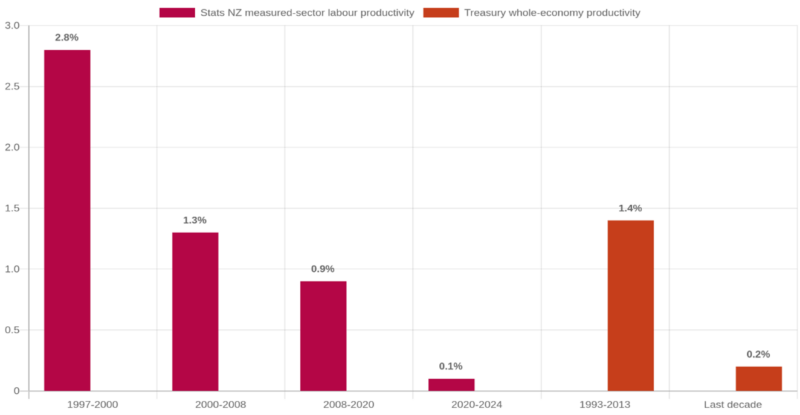
The numbers are hard to ignore. Stats NZ shows measured-sector labour productivity growth slowing across successive cycles: 2.8 percent per annum from 1997 to 2000, 1.3 percent from 2000 to 2008, 0.9 percent from 2008 to 2020, and only 0.1 percent from 2020 to 2024.
Treasury makes the same point at whole-economy level: productivity growth averaged 1.4 percent per annum between 1993 and 2013, but only 0.2 percent per annum over the last decade.
New Zealand Productivity Growth 1997-2026
Whilst some of the statistics reflect scale, distance, capital intensity, competition, and investment, they are not the whole story.
New Zealand was once a much higher-income economy by OECD standards; in the early 1970s, Treasury had previously noted New Zealand’s GDP per capita was around 15 percent above the OECD average and ranked eighth in the OECD.
Geography did not suddenly appear after that. New Zealand is falling behind partly because we have not adopted core operational disciplines. Lean, industrial engineering, operational excellence, structured problem solving, standard work, visual performance, root cause analysis, value stream thinking and daily management are not side activities. They are how firms convert effort, technology, and capital into better output per hour.
This is not a “party-political” critique; however, based on official public biographies, the current Cabinet does not appear to include ministers with clear manufacturing operations, lean transformation, industrial engineering, or operational excellence leadership experience.
There is adjacent experience in consumer products, Fonterra, export sales, engineering, and factory work, but that is different from having had to lift output, reduce waste, improve flow, stabilise processes and sustain performance in an operating environment.
The former government had similar gaps. It had strong backgrounds in education, health, law, finance, public service, local government, agriculture, and trade. It had ministers with primary sector, economic development, and export portfolios.
But again, there was little visible evidence of manufacturing operations, Lean, industrial engineering, or operational excellence leadership experience at the Cabinet level.
This absence is significant because productivity is frequently viewed as a macroeconomic aspiration rather than a vital operational capability. While we often discuss innovation, investment, skills, and technology, we tend to underinvest in the essential routines that turn these ambitions into reality.
Key areas such as process discipline, frontline capability, management cadence, problem-solving, and sustained improvement are a must if we want to achieve tangible results in productivity.
The education system shows the same gap
Advanced economies treat industrial engineering as a serious productivity discipline. In the United States, the American Society for Engineering Education reported 18,684 undergraduate enrolments and 5,847 bachelor’s degrees awarded in Industrial, Manufacturing and Systems Engineering in 2023. These are people trained to optimise systems, improve flow, manage constraints, reduce waste, and improve operational performance.
New Zealand’s equivalent pipeline is much thinner and less visible. Ministry of Education data, presented by Figure.NZ, shows 6,905 students in 2025 in the broad field of mechanical and industrial engineering and technology across all tertiary levels, with only 580 at bachelor’s degree level.
That category includes mechanical as well as industrial engineering, so it overstates the pure industrial engineering pipeline.
Engineering New Zealand’s accredited degree list shows Industrial Engineering as a previously offered programme, not a visible current mainstream pathway.
That makes little sense for a country with a productivity problem. Industrial engineering is not an academic luxury. It is the discipline closest to the daily work of productivity: production systems, logistics, process design, simulation, scheduling, cost, flow, ergonomics, and human performance.
If New Zealand wants more productive firms, we should be producing more people trained to design and improve productive systems.
The vocational pathway is also weak
Australia has active, funded pathways for Competitive Systems and Practices, the operational excellence qualification family that directly aligns with New Zealand’s new Operational Excellence qualifications.
Queensland has a fully funded Operational Excellence Program for eligible manufacturing employees, covering Certificate III and Certificate IV in Competitive Systems and Practices.
The Australian qualifications themselves are clearly about applying and facilitating improvement practices, including waste reduction, root cause analysis, standard work, 5S, value stream mapping, process capability, and sustained improvement.
New Zealand has the qualification architecture, but not the delivery. NZQA lists current Operational Excellence qualifications at Levels 3, 4 and 5 – each with a highly relevant purpose: Level 3 develops people who can identify waste and sustain improvements in their own work; Level 4 develops people who can lead operational excellence activity and facilitate culture change; Level 5 develops people who can plan, implement, measure and drive operational excellence across a business unit or smaller organisation.
NZQA currently lists no education organisations offering the new Level 3, Level 4, or Level 5 qualifications. That is not a criticism of CSP.
It is the opposite. CSP, now Operational Excellence, is one of the few structured pathways New Zealand has for building practical productivity capability in the workplace.
The problem is systemic: the pathway exists on paper, but not in practice. If there are no providers, there is no real pathway. If there is no pathway, there is no practical funding signal to employers.
Capability development becomes ad hoc: a workshop here, a consultant-led event there, a 5S activity, a value stream map, then a slow drift back to old routines. That is not how a country builds productivity capability at scale.
Lean adoption requires strong leadership, not just tools.
Evidence on management practices supports this view. The World Management Survey found New Zealand manufacturing firms have a substantial tail of mediocre management practice, especially in people management.
Furthermore, the quality of management links directly to productivity levels, highlighting the need for more effective management to drive performance improvement.
New Zealand Lean research has also shown a familiar pattern: companies can get initial benefits from Lean, but struggle to sustain the transformation because leadership, strategy alignment, behaviour, and engagement are not strong enough.
Lean does not fail because 5S, standard work or root cause analysis are weak tools. It fails when the operating system around those tools is weak. It fails when leaders do not set standards, coach routines, manage resistance and hold the gains.
At Argon & Co, we see positive outcomes associated with strong operational discipline. Businesses that take operational discipline seriously tend to perform better.
Two organisations we know well, recently received significant external recognition. Gallagher Group won both the Supreme Award and Best Large Business at the 2025 New Zealand International Business Awards. T&G Global won the Food, Beverage, and Fibre Producer Award at the 2026 Primary Industries Awards, with judges praising its premium brand performance and integrated end-to-end management platform.
It would be misleading to claim these successes were solely due to Lean practices. Credit where credit is due, these organisations have strong products, markets, leadership, and strategies.
But the consistent pattern we observe in practice suggests that companies that build disciplined operating systems, that invest in people and that commit to improving the work practices are more likely to sustain high performance.
Digital and AI will not solve productivity problems – they will expose them. A team that does not understand its process will use digital tools to move poor work faster.
A leader who cannot read a performance board will not become effective because the dashboard is automated. AI can help analyse and accelerate improvement work, but only if people know what problem they are trying to solve and what good looks like operationally.
What should change?
If New Zealand wants to improve productivity, operational excellence capability must be treated as national infrastructure, not an optional training product.
Industry Skills Boards need to actively steward the pathway. Approved providers need to deliver new Level 3, Level 4 and Level 5 programmes, or form partnerships with practitioners who have the operational credibility to make learning effective. Universities should re-evaluate their approach to industrial engineering, considering our country’s productivity challenges.
We need to ask why we lack a robust national pathway in a discipline so closely tied to productivity. Simultaneously, employers must cultivate demand by integrating operational excellence into the development of operators, supervisors, team leaders, and middle managers. This alignment will help foster the skills necessary to address our productivity issues effectively.
New Zealand’s productivity gap will not close because we rename qualifications, buy new software or agree the issue is important.
New Zealand’s productivity gap will close when more people in more workplaces know how to improve processes, their work, lead routines, and sustain gains.


