
doug
Posts by Doug Green:
ArtCAM Pro allows the most complex designs to be modelled and machined
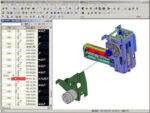
Delcam’s ArtCAM Pro CADCAM software for artistic applications has made it much easier to create complex designs, with a new approach called interactive distortion modelling. This allows users to distort either vectors or reliefs within ArtCAM models by bending or stretching the design, and to see the results in real time. Unlike most other CADCAM systems, ArtCAM Pro is aimed at skilled artisans rather than engineers and requires little knowledge of engineering or computing. It has been particularly successful in the signmaking, woodworking and engraving industries. In these areas and in other artistic applications, ArtCAM Pro allows users to increase productivity, improve quality and deliver new designs more quickly, by combining their craft skills and creativity with the power and precision of computer-aided manufacturing. The addition of interactive distortion modelling in the latest release makes ArtCAM’s unique free-relief modelling even more powerful. Interactive distortion modelling makes it possible to create the most complex shapes quickly and easily, with the ability to see the effects of any changes as they are being made. Once the design of the particular element has been finalised, it can be moved, rotated, rescaled and copied, either individually or as part of a group. Any part of the design can be isolated, edited and then recombined into a group for duplication or further editing within the group. At any stage in the process, either individual items or a group of items can be saved within ArtCAM Pro’s clipart library for use in future projects. A second major focus in the new release is on vector creation and editing. New snapping options make vector creation much quicker. They include the ability to snap to anything in the design, including any point on a vector, intersections between vectors, guidelines and key points within a model, such as the […]
Sistema invest $6M to expand NZ manufacturing
Sistema has imported a 1,300 and a 650 tonne injection moulding machine to boost its manufacturing operations in New Zealand, allowing the company to create a new range of durable plastic home and office storage products made exclusively for The Warehouse. The 1,300 tonne machine is one of the biggest of its type brought into New Zealand during the last 20 years according to Sistema’s managing director Brendan Lindsay. “This equipment is a one-of-a- kind industrial machine. I have not heard of any other company bringing in a similar machine to manufacture products like this in New Zealand.” “This investment has allowed us to diversify our product offering and produce heavy duty storage containers ranging in capacity from 14 to 90 litres. The range will include utility trays and organiser tubs, filing clips and removable wheels, making them the most sophisticated plastic box storage system on the market,” said Mr Lindsay. The company is proud to collaborate with The Warehouse to bring this newest offering to the public, with the storage range going on sale this month. TW Group CEO Mark Powell considers this a smart business move. “We have formed a long term partnership with Sistema to support the development and manufacture of this product, which reflects our commitment to stock New Zealand made products.” Sistema’s business has evolved dramatically growing from a simple backyard garage operation 30 years ago to an international success story today. “We now export our products to more than 65 countries around the world, including the United States, the UK, Europe and South Africa, but we are committed to keeping our manufacturing in New Zealand,” said Mr Lindsay. In March 2012, Prime Minister John Key opened Sistema’s new $7.5 million purpose-built production factory, allowing the company to establish an additional 50 jobs. The company currently employs more than 540 staff.
Energy conversion principle to double engine efficiency
Professor Ken Naitoh of Waseda University’s Faculty of Science and Engineering (Department of Applied Mechanics and Aerospace Engineering, School of Fundamental Science and Engineering) and his associates have discovered a revolutionary energy conversion principle (new compressive combustion principle) able to yield stand-alone engines with double or higher the thermal efficiency potential of conventional engines, independent of their size. If engines utilising this principle can be put to use in practical applications, it is believed that they could become innovations with the ability to solve today’s immediate environmental energy problems. This new compressive combustion principle was formulated by Professor Naitoh through the development of a new thermofluid dynamics theory, as well as thought experiments, supercomputer simulations, and high-speed airflow experiments drawing on that theory. The fundamental principle is that while thermal efficiency can be raised by reaching a high compression ratio, achieved through pulsed collisions of multiple high-speed jets of an air-fuel gas mixture at microscopic regions in the central area of a combustion chamber, expanded uses and ranges of application were attained with the further addition of 3 new measures. This method is also considered to be lower in cost than batteries, as well as having possibilities for noise reduction and the potential to eliminate the need for cooling mechanisms. If the effectiveness of this principle can be confirmed through combustion tests, it will not only open up the doors to new lightweight, high-performance aerospace vehicles, but would also lead to prospects of next-generation, high-performance engines for automobiles. The maximum thermal efficiency of present-day gasoline engines for automobiles is on the order of 30%, believed to fall to a level as low as 15% in states from idling to low-speed city driving. Therefore, if automobiles could be equipped with ‘low-cost, ultimate-efficiency engines’, reaching a stand-alone thermal efficiency of 60% or […]
Celebrating Kiwi ingenuity
Kiwi Ingenuity should be celebrated as much and even more than the glorious achievements of the All Blacks on the Rugby field. By Joel Leonard New Zealand is more than a haven for Hobbits, champion rugby teams, picturesque scenery, and adventurous vacations. Also a haven for Kiwi-Ingenuity! Kiwi Ingenuity has evolved to become the real national treasure for New Zealand. Located over 900 away from Australia, New Zealanders, or Kiwis have had to become very resourceful in order to cope with their remoteness and as a result have been forced to invent their own solutions and have been able to maximise their creativity, otherwise known as Kiwi-Ingenuity. Have you ever heard about Jetboats? From Wikipedia- A jetboat is a boat propelled by a jet of water ejected from the back of the craft. Unlike a powerboat or motorboat that uses a propeller in the water below or behind the boat, a jetboat draws the water from under the boat into a pump inside the boat, then expels it through a nozzle at the stern. Jetboats were originally designed by Sir William Hamilton (who developed a waterjet in 1954) for operation in the fast-flowing and shallow rivers of New Zealand, specifically to overcome the problem of propellers striking rocks in such waters. Previous attempts at waterjet propulsion had very short lifetimes, generally due to the inefficient design of the units and the fact that they offered few advantages over conventional propellers. Unlike these previous waterjet developments, such as Campini’s and the Hanley Hydrojet, Hamilton had a specific need for a propulsion system to operate in very-shallow water, and the waterjet proved to be the ideal solution. From this, the popularity of the jet unit and jetboat increased rapidly. Through further developments, it was found the waterjet offered several other advantages over […]
Steel industry cautious on new Christchurch investment fund
New Zealand’s structural steel industry says the announcement of a planned new investment fund for the Christchurch rebuild is good news for the city, however it remains to be seen whether it will end up costing Kiwis their jobs. Steel Construction New Zealand Manager Alistair Fussell says he welcomes initiatives which help deliver the high-quality building and infrastructure projects needed to rebuild Christchurch. “On the face of it, it is good news for Christchurch, especially if it helps speed up development. But we’re reserving judgement until more is known about the downstream effects of this agreement between Guoxin International and Christchurch City Council. “Our main concern is that importing capital, materials and skills from overseas could lead to the loss of local jobs – not just in the structural steel industry, but right across the building supply chain.” There is a proven economic case for awarding tenders to local suppliers, says Mr Fussell. “A New Zealand fabrication firm recently bid for a structural steel contract worth $34 million. However, keeping it local would attract an additional GDP contribution of $14.1 million – an economic multiplier of 1.4 – as well as a tax contribution of $3.3 million. “There’s a significant economic uplift when local materials and labour are used. We have more than enough capacity in the local industry to deliver the structural steel volumes required to rebuild Christchurch, so we’re saying let’s think about the consequences very carefully,” says Mr Fussell. Christchurch City Council’s procurement policy states that tendering processes for public projects must be equitable and transparent. Mr Fussell says while the policy does provide some comfort, it remained to be seen how closely the Council would adhere to its own rules with respect to the Guoxin International fund. “We certainly hope the Council follows its key procurement […]
Growing regional research initiatives
While emerging or fledgling industries do exist, the missing link that should sit alongside this initiate is serious and comprehensive industry development activity, so that industry can grow swiftly to a level where it really can use and exploit the science developed and make a real contribution to regional development. Commentary by HERA Industry Development General Manager Nick Inskip Announced in the Budget on the 21st May was an item around the establishment of independent regional research institutes. The intent being that the Government would provide funding towards the establishment of a number of institutes to be located in regional areas and not in the three large centres of Auckland, Wellington and Christchurch. The model espoused was something like the role taken by the Cawthron Institute, which is located in Nelson and serves the needs of the aquaculture and marine ecology community. Cawthron has a history of almost a hundred years and employs around 200 hundred people. It is interesting to see how Cawthron has evolved from an initial concept – a technical institute to be developed from a bequest from Thomas Cawthron – into an institute that has developed alongside an industry and at various times has led, supported or followed its development. As an aspirational model Cawthron is excellent; it has critical mass to survive and even thrive outside a major city and has been well-supported by Government over the years. The intent of the new institutes is that they will operate as private, independently-governed entities working closely with industry and other regional actors to stimulate new leading-edge, commercially-focused and industrially exploitable research. A series of Regional Research Institutes Workshops have been held around the country with the intent of seeking input to the proposed initiative, and introducing high-level aims and eligibility requirements. So far, the workshops have […]
RBNZ holds OCR, challenges remain
The Reserve Bank of New Zealand (RBNZ) chose to hold the OCR at 2.75% today, though signalling further reductions may be required to reach their inflation target. Economic risks remain, and continued work from Government and business is needed to rebalance our economy towards high value-added, diverse exports, say the New Zealand Manufacturers and Exporters Association (NZMEA). NZMEA Chief Executive Dieter Adam says, “Another cut in the OCR could have helped better align our interest rates with the rest of the world and help move our exchange rate back down its correcting path. Unfortunately we have seen our exchange rate move in the wrong direction recently, as described by the RBNZ “the exchange rate has been moving higher since September, which could, if sustained, dampen tradables sector activity and medium term inflation. This would require a lower interest rate path than would otherwise be the case”. “It remains important that our currency continues on its rebalancing trend, helping exporters to regain ground in markets after the extended period of an unsustainable exchange rate. “This week’s merchandise trade deficit came in larger than expected, due to increased imports and lower export values, largely fuelled by the fall in dairy prices and volumes. However, it was encouraging to see mechanical machinery and equipment continue recent positive trends in export values; improving 3.6% on last quarter, and increasing 6.6% on the same quarter last year. “As a country we need to continue to rebalance our economy away from investment in unproductive assets and towards a more diverse, value-added export economy that allows us to pay our way in the world and improve all New Zealanders quality of life. This requires both helping commodity producers move up the value chain, as well as encouraging and supporting higher-value, highly-skilled manufacturing and exporting businesses that build […]
AccuPRO UV and white light meter combine sensors
The AccuPRO Series of digital radiometer/photometers measures and displays UV and white light readings simultaneously. The AccuPRO series includes two new models: the standard AccuPro (XP-2000) with a dual-wavelength sensor that measures both ultraviolet and visible light. The AccuPRO Plus (XP-4000) 3-in-1 multi-purpose sensor capable of measuring ultraviolet, visible and blue light. Both units comply with ASTM specifications for MPI and FPI, making them the ideal companion for NDT. The instrument has internal batteries that are charged by USB input. The portable, palm-sized units feature a large colour LCD screen, protective rubber housing and a three-way button interface which makes it fast and convenient to toggle between measurement modes. Overall accuracy is better than ± 5% per NIST standards. The AccuPro series is user-friendly and intuitive.
Supply Chain Excellence: Series 1 – Understanding the Supply Chain
https://www.nzpics.org.nz-Vishnu Rayapeddi Whenever we ask what supply chain is, we get different answers depending who we ask. Some say it is planning & purchasing or procurement and some say inventory management and some others may say it is logistics management. Yes all these correct answers. But there is much more! According to APICS (Association for Operations & Supply Chain Professionals, USA) dictionary, “Supply Chain Operations Reference (SCOR®) model” is “A process reference model developed and endorsed by the Supply Chain Council as the cross-industry, standard diagnostic tool for supply chain management. “The SCOR model describes the business activities associated with satisfying a customer’s demand, which include plan, source, make, deliver, and return. Use of the model includes analysing the current state of a company’s processes and goals, quantifying operational performance, and comparing company performance to benchmark data. SCOR has developed a set of metrics for supply chain performance, and Supply Chain Council members have formed industry groups to collect best practices information that companies can use to evaluate their supply chain performance”. In essence, the SCOR Framework is the world’s leading supply chain framework, linking business processes, performance metrics, practices and people skills into a unified structure. By deploying the SCOR framework at your organization you can: 1) Increase the speed of system, 2) Implement Support organizational learning goals, and 3) Improve inventory turns. Level 1 Processes included in SCOR are: Plan, Source, Make, Deliver, Return and Enable Level 1 Metrics included in SCOR are: a) Perfect order fulfilment, b) Order fulfilment cycle time, c) Upside supply chain flexibility, d) Upside supply chain adaptability, e) Downside supply chain adaptability, f) Overall value at risk, g) Total cost to serve, h) Cash-to-cash cycle time, i) Return on supply chain fixed assets, j) Return on working capital. So, how do we define […]