
Better thinking, better results: The two-day world class productivity simulation that builds capability
 By Neil Robinson, a Senior Business Consultant with Argon & Co (Auckland) specialising in productivity improvement, Lean systems and capability building.
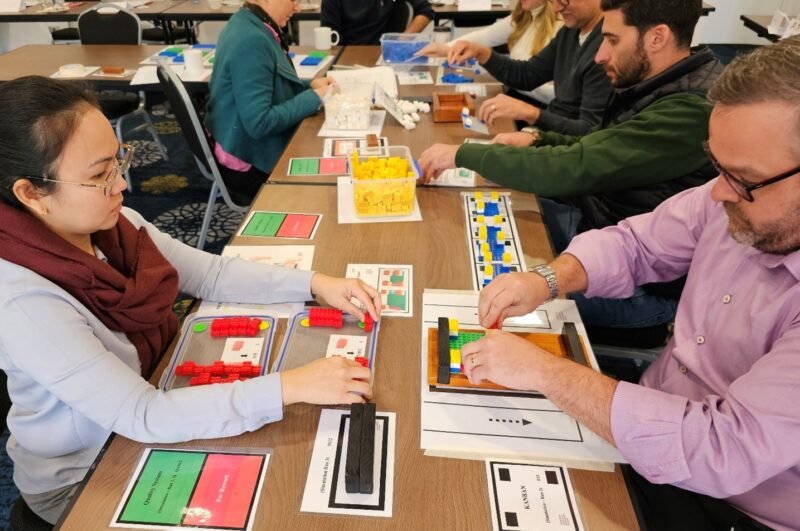
Welcome back! If you joined us for Article 1, you’ll remember how the World Class Productivity Simulation gives teams a powerful, hands-on experience of what helps — and what hinders — operational performance. Many participants leave that first session with a renewed sense of possibility.
“The only sustainable competitive advantage is an organisation’s ability to learn faster than the competition.”
— Peter Senge
In manufacturing, it’s easy to fall into a trap: when performance dips, the organisation responds with speed — quick fixes, point solutions, and local optimisation.
Sometimes that helps. Often it creates new problems elsewhere, because the symptom wasn’t necessarily the system driver.
A more reliable approach is to build the capability to think well about improvement — to see what’s really happening, understand what the customer needs, consider the organisation’s direction, and make decisions that improve the whole system rather than one corner of it.
That’s the purpose of the two-day World Class Productivity Simulation. Day one creates an unforgettable experience of flow, waste and performance. Day two builds something more enduring: the ability to learn as a team and apply a repeatable method for choosing improvements that stick.
Even if you never attend the simulation, the principles below will strengthen your own improvement conversations.
- The difference between activity and improvement
Many sites have no shortage of improvement activity. The real question is whether that activity is producing better system performance: more reliable output, improved quality and delivery, lower cost, safer work, and less firefighting. A simple test is to ask:
-
What problem are we solving — and how do we know?
- What customer need does this improvement protect or enhance?
- Which part of the system will change — and what else will it affect?
- What will we measure to confirm it worked?
When teams can answer those clearly, improvement compounds. When they can’t, improvement often becomes “busy work” — lots of motion, limited lift.
- Five practical thinking principles
- a) Start with customer value.
Local decisions can make sense — until you look from the customer’s perspective. Try adding one question to your daily meeting: “What did the customer need from us yesterday — and did we deliver it?” - b) Improve the system, not the symptom.
Point solutions are tempting because they’re fast. But if the root cause sits elsewhere, symptoms return — often with extra complexity. When an issue appears, ask: “Is this the constraint — or a symptom of something upstream?” - c) Consider stakeholder needs (and hidden conflicts).
Improvement often stalls because needs collide: Production wants output now; Quality wants stability; Engineering needs downtime windows; Planning wants schedule adherence; Operators need clarity and less rework. Before implementing change, ask: “Which two groups will this impact most — and have we involved them?” - d) Align improvements to direction and vision.
Factories have more ideas than capacity to execute. Filter ideas through: Does it improve end-to-end flow? Does it lift delivery, quality, safety or cost measurably? Does it align to business priorities? Can we trial it quickly and safely? A simple exercise: bucket your top ideas into Must do / Should do / Nice to do — then ask, “What are we not doing so we can do the must-dos well?” - e) Use a repeatable learning cycle.
Plan, deeply understand the situation, generate options and design counter measures. Do, trial deliberately. Check, review and learn, Act or Adjust, modify your approach if needed, standardise what works — then repeat. After any action on the process ask: “What did we learn?” - Why two days make the difference
The one-day experience creates energy and insight. The two-day experience builds capability — because it gives time to practise the thinking, evaluate trade-offs, and connect improvements to real workplace needs.
Participants leave with a stronger ability to see the system, a practical way to choose improvements, a shared language across roles, and a prioritised improvement list they can apply back at work. That’s better thinking — and it produces better results.
Next: In Article 3, we’ll explore how the digital version uses real-time data to accelerate learning — making variation and time loss visible and strengthening the link between process improvement and modern digital operations.
Neil Robinson
021 873 214 | neil.robinson@argonandco.com


