
Data, Decisions, and the Drive for Productivity, A Digital Path to World Class Performance
Article 3: V2
 –By Neil Robinson, a Senior Business Consultant with Argon & Co (Auckland) specialising in productivity improvement, Lean systems and capability building.
If you’re reading this third article in the series, you already know that New Zealand manufacturers face a difficult reality: our productivity lags many of the countries we compete with.
Labour is tight, costs continue to rise, and customers expect more value delivered faster and with fewer errors. This situation demands stronger, more reliable processes.
Many operational leaders feel this pressure daily. The question is no longer “Should we improve?” It’s “How can we improve quickly, sustainably, and with the people we already have?”
The good news is that there is a practical way forward. More leaders are turning to hands-on capability building, such as the 4×4 Simulation, to lift performance from the inside out.
In Article 1, we explored how teams experience the shift from chaos to flow. In Article 2, we looked at how the deeper two-day version helps participants understand why improvements work and how to apply them in their own workplace.
Now we arrive at the next evolution: the Digital 4×4 Simulation, where participants combine practical learning with real-time operational data to accelerate improvement.
1.1 Why New Zealand Needs This Now
New Zealand’s productivity challenge is well documented. We work hard, often very hard, but too often our processes let us down. Unreliable flow, inconsistent standards, firefighting, quality escapes, poor teamwork, unbalanced workloads, and slow changeovers all eat into profit.
Software alone is not the answer. Automation alone cannot fix this. Even continuous improvement programmes struggle if the foundation of process stability is not in place.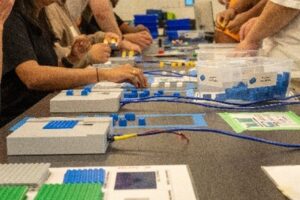
This is why the Digital 4×4 matters. It helps teams see, understand, and improve the behaviours and systems that control productivity, then strengthens that learning with digital insights that make improvement faster, clearer, and more repeatable.
For many organisations, this is a relief: a practical, enjoyable, proven way to build the capability needed to become more competitive.
1.2 Round 1: Chaos and Discovery
As with the manual versions, Digital 4×4 begins with Round 1, a fast, frantic test of the team’s ability to assemble the product under conditions that mirror real-world instability.
Importantly, data is still collected manually at this stage. Why? Because the chaos is obvious. A dashboard would simply confirm what everyone already sees and feels. In this data-poor environment, participants experience the true cost of instability, which builds honesty, empathy, and shared recognition.
Leaders often say after Round 1, “That felt surprisingly familiar.”
Once participants have experienced the pain of poor flow, we begin teaching the best practices that reduce variation, stabilise work, and lay the foundation for improved performance.
1.3 Round 2: Introducing Data to Accelerate Improvement
By the time Round 2 begins, the team has learned and applied several improvements. The system is still developing, but basic stability has emerged. This is the ideal moment to introduce digital data.
Each workstation is equipped with sensors to measure cycle times, waiting time, throughput, idle periods, and bottleneck formation. At the round’s end, a dashboard report shows the effect of the changes and highlights where more work is needed.
Now participants can compare what they thought was happening, what they observed, and what the data shows.
This builds trust in data and accelerates learning. Balanced workloads produce smoother cycle time graphs. Better layout shortens queues and lifts throughput. Quality at source reduces rework spikes. Shorter changeovers reduce downtime sharply.
Participants begin to see the process like experienced analysts, recognising patterns, questioning variation, and identifying where targeted changes will have the greatest impact.
1.4 Round 3: Real-Time Improvement, Using Data as You Work
In Round 3, everything comes together. Participants now understand the simulation, the principles, and the data. Most importantly, they trust the data.
The round becomes a live improvement environment where the team watches the dashboard as they work, identifies issues as they appear, and intervenes during the run to correct them.
This mirrors the behaviour of world-class manufacturers, who use real-time data to maintain flow, reduce variation, and prevent bottlenecks before they affect customers.
Something important happens in this round. Teams stop reacting emotionally or relying on assumptions. They begin responding rationally, using evidence, context, and collaboration.
This is modern operational excellence, and the result is a more confident, capable, and data-literate workforce.
1.5 A Capability New Zealand Needs
For NZ manufacturers under pressure to improve productivity, the Digital 4×4 Simulation offers three critical capabilities.
- Deep process understanding
Participants learn why processes behave the way they do. - Accelerated improvement through data
People learn to interpret variation, trust metrics, and act on evidence. - A practical path to Industry 4.0
Before investing in sensors, automation, or advanced analytics, teams learn how to use data effectively in a safe, “hands-on” environment.
For many organisations, this combination is the missing link between wanting better performance and achieving it.
1.6 Relief, Clarity, and a Way Forward
Productivity pressures are not going away. Competition is not easing. Customers are not lowering their expectations.
But the Digital 4×4 Simulation shows that progress is achievable. It gives teams clarity, confidence, and a shared experience of what better looks like.
For leaders, it offers something rare: relief that productive, sustainable change is possible, not through expensive programmes, but through practical learning that teams genuinely enjoy.
Ready to move? Call or email today and we’ll confirm suitability and secure a delivery window. Neil Robinson 021 873 214 neil.robinson@argonandco.com


