
Sustainability: Digital product passports and the MCI – a practical guide for manufacturers
From June issue, NZ Manufacturer magazine
Manufacturers are being asked to answer harder questions about their products: What are they made from? Where did the materials come from? Can they be repaired, reused or recycled? And can those claims be verified?
Digital product passports (DPPs) are emerging as a practical answer. They give each product a digital record that can travel with it through the value chain, making trusted information easier to share, update and use. For manufacturers, this is becoming a way to prepare for changing regulations, support circular economy goals and make product data more useful for customers, suppliers and recyclers.
Manufacturers are also under pressure to prove claims around recycled content, durability and end-of-life recovery. Together, DPPs and the Material Circularity Indicator (MCI) can provide a practical way to measure and communicate circularity performance.
What is a digital product passport?
A digital product passport is a structured digital record that stores and shares information about a product across its life cycle.
It can bring together technical specifications, material composition, recycled content, installation and repair manuals, end of use pathways, chemicals of concern, and other product details in one digital thread.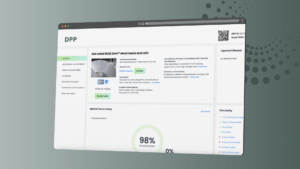
Digital product passport information can sit with each product, using a QR code, RFID tag or other digital identifier.
It can also be managed across a whole project through systems like Rosella Street, an Australian-built platform that helps manufacturers and project teams collect, manage and report passport data.
The idea may sound technical, but the purpose is simple: to give procurement officers, project teams, asset managers, deconstruction crews, recyclers and regulators reliable product information when they need it.
As Jim Goddin, thinkstep-anz’s Head of Circular Economy explains, product information is increasingly expected to move with the product itself.
Mick Fritschy, Director and Co-founder of enterprise software company Rosella Street, agrees. The business focuses on helping organisations implement digital product passports solutions.
This includes manufacturers, asset owners, project managers, sustainability teams and supply chain partners looking to meet compliance obligations, improve product transparency and support better circularity outcomes.
Mick describes digital product passports as more than static records. “A digital product passport is distinct from a normal static digital record in that it’s a dynamic record that updates across its life.” Rather than relying on disconnected spreadsheets, PDFs and supplier declarations, DPPs create a single, high trust, source of truth in machine-readable format that supports automated reporting and can be updated throughout a product’s life
Why manufacturers should pay attention now
Much of the momentum behind DPPs is coming from regulation. The European Union’s Ecodesign for Sustainable Products Regulation (ESPR) will progressively introduce digital product passport requirements across a range of product categories.
Construction materials including iron, steel and aluminium and textiles and footwear are among the first sectors affected, but requirements are expected to expand into other industries over time.
Even manufacturers outside Europe should pay attention, particularly those supplying global supply chains or multinational organisations preparing for compliance.
DPPs are becoming important beyond regulation, with customers, procurement frameworks and rating systems increasingly expecting verified product sustainability and circularity information.
Jim says, the shift is already underway. “It’s being picked up quite broadly and used as a means of communicating circularity of products.” This means DPPs are becoming part of how products are specified, compared and selected.
What is the MCI?
The Material Circularity Indicator (MCI) is a methodology developed by the Ellen MacArthur Foundation to measure how circular a product is.
The MCI produces a score between 0% and 100% circularity based on factors such as:
- Material inputs – how much virgin material is avoided
- Material outputs – how much waste is prevented
- Use – how effectively the product is used
Importantly, the MCI brings multiple circular economy concepts together into one comparable metric.
As Jim, who co-developed the methodology explains, “the MCI produces a single metric that’s comparable across all of the different models.” Manufacturers often struggle to compare different circular strategies, and the MCI provides a consistent way to assess them.
“One of the reasons we love the MCI indicator is it gives that overview of circularity,” Mick adds. “It’s a great metric because it’s quite hard when you’re looking to consider across the board all the different circular elements that could potentially make a difference to the future circularity of the product.”
The MCI is also increasingly recognised across industry frameworks and standards. It has informed ISO 59020 and is being referenced in certification systems and digital product passport platforms.
Why the MCI matters for manufacturers
The MCI helps manufacturers understand where circularity performance comes from and where improvements can be made.
For example, using a tool like thinkstep-anz’s MCI Pro it’s easy to show how much of a product’s circularity comes from material inputs, end-of-life outcomes or product longevity. This makes it a practical design and decision-making tool.
A manufacturer might discover that a product already contains high recycled content but performs poorly because components are difficult to disassemble or recover.
Another product might achieve strong circularity performance through long service life.
The MCI can help manufacturers improve product design, make better procurement decisions and strengthen customer communication.
How digital product passports and the MCI work together
DPPs and the MCI are most powerful when used together. The DPP acts as the delivery mechanism for product information, while the MCI provides a measurable circularity metric within that system.
In practical terms, a DPP can include the product’s MCI score, the assumptions behind that score and detailed information about material composition, repair and maintenance requirements, recovery pathways and how the product changes throughout its life cycle.
This is particularly useful because circularity is not static. As products are repaired, reused, refurbished or recovered differently across markets, circularity outcomes can change over time. “The live or updatable MCI is really useful for projects and reporting because it reflects the circularity as it evolves throughout the lifecycle of the product,” Jim explains.
This helps manufacturers move beyond one-off sustainability claims and provide ongoing, evidence-based product information.


